
Plants Mistaken for Japanese Knotweed: 7 Common Lookalikes and How to Tell
Plenty of garden plants and weeds look a bit like Japanese knotweed at first glance, especially in summer when everything is green and tall. Getting it wrong either way is costly: mistaking a harmless plant for knotweed can cause needless worry and delay a sale, while mistaking knotweed for something harmless can let it spread. This guide covers the lookalikes the Royal Horticultural Society (RHS) and other sources flag most often, and the quick checks that separate them.
First, the four checks that matter most
Before comparing plants, look for these features of Japanese knotweed, as described by the RHS:
- Stems: upright, bamboo-like, with nodes, reddish-purple speckles and hollow centres.
- Leaves: spade-shaped with a flattish base, usually about 14cm long.
- Leaf arrangement: alternate, in a zig-zag along the stem, not in opposite pairs.
- Flowers: small creamy-white clusters near the stem tips in late summer and early autumn.
A plant that fails two or more of these is probably something else. For a full seasonal guide, see knotweed in summer and autumn.
1. Russian vine (Fallopia baldschuanica)
Russian vine, sometimes called mile-a-minute, is a close relative and is listed by the RHS as a common confusion. It produces similar sprays of white flowers in summer and has heart-shaped leaves.
How to tell: Russian vine is a twining climber. It scrambles over fences, sheds and trees rather than standing up as self-supporting canes. Its stems are thin and wiry, not thick and hollow.
2. Himalayan honeysuckle (Leycesteria formosa)
Another RHS-listed lookalike. It has hollow stems and grows into upright clumps, which is why it gets mistaken for knotweed.
How to tell: its leaves grow in opposite pairs, not a zig-zag. Its stems are usually plain green to blue-green without knotweed's speckling, and in summer it carries hanging tassels of white flowers with purplish bracts, followed by dark berries. Japanese knotweed does not produce berries.
3. Himalayan balsam (Impatiens glandulifera)
Himalayan balsam is an invasive non-native plant of riverbanks and damp ground, often found in the same places as knotweed. It has tall, hollow, reddish stems.
How to tell: balsam has long, narrow, toothed leaves rather than spade-shaped ones, often in pairs or whorls. Its flowers are pink to purple and slipper-shaped, and its seed pods burst when touched. It is an annual with shallow roots that pull up easily; knotweed has deep rhizomes.
4. Bindweed (Calystegia and Convolvulus)
Bindweed has heart- or arrow-shaped leaves that can look similar when you see a single leaf.
How to tell: bindweed stems are thin and twining, wrapping around other plants and supports, and it has white or pink trumpet-shaped flowers. It never forms stiff upright canes.
5. Fish mint (Houttuynia cordata)
The RHS lists this ornamental groundcover among plants confused with knotweed, mainly because of its heart-shaped leaves and reddish tints.
How to tell: it is low-growing, usually forming a carpet rather than tall canes, and its leaves give off a strong smell when crushed.
6. Other knotweeds and Persicaria
The RHS notes that small-headed knotweed (Persicaria microcephala) and several Persicaria and Polygonum species, including annual weeds such as pale persicaria and redshank, can be confused with Japanese knotweed. These are generally much smaller and less invasive.
Be careful with giant knotweed and the hybrid between giant and Japanese knotweed. The RHS says giant knotweed is also listed on Schedule 9 of the Wildlife and Countryside Act 1981, as is the hybrid. Giant knotweed is larger in every way. There is also a shorter variety, Reynoutria japonica var. compacta, which the RHS says is still invasive. If you find any of these, treat them as seriously as Japanese knotweed.
7. Bamboo
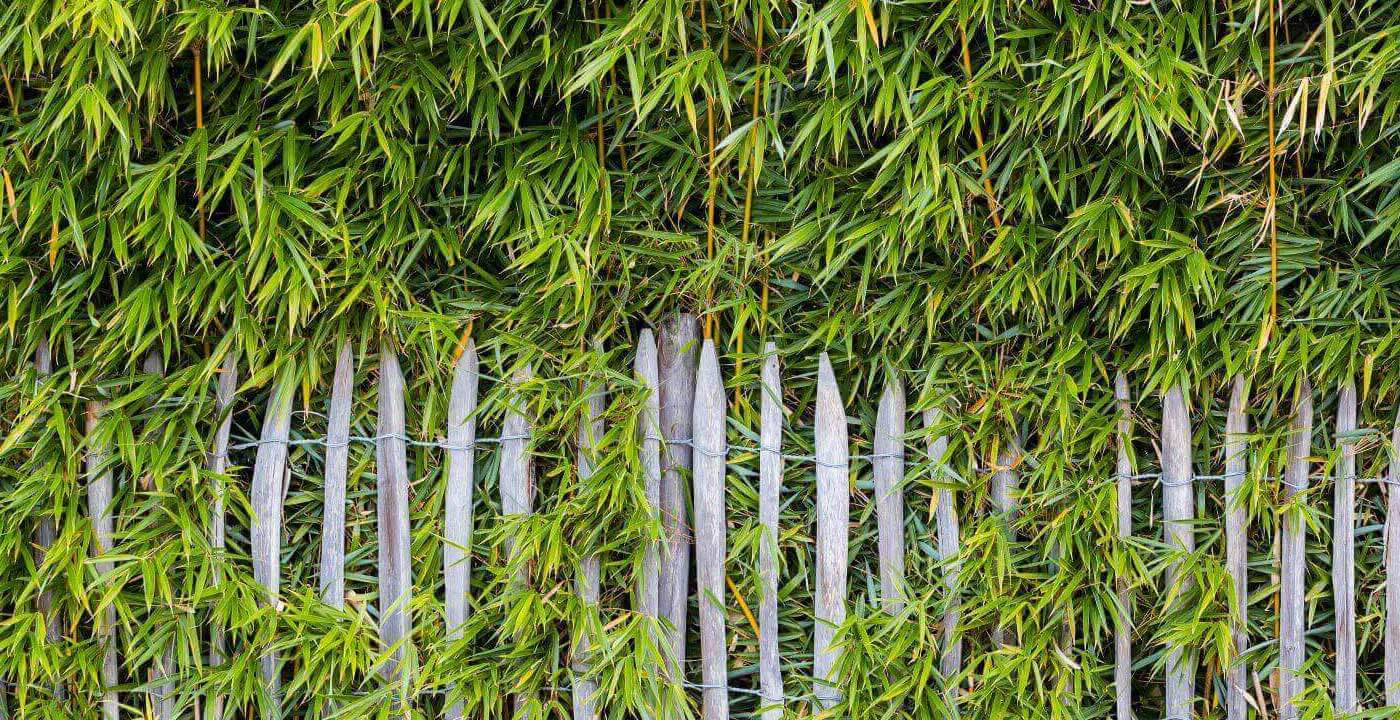
Bamboo is the classic confusion because both have jointed canes. Bamboo canes are typically woody and stay green through winter, and bamboo leaves are long and narrow, quite unlike knotweed's spade-shaped leaves. Running bamboo can also spread aggressively. Our full guide covers Japanese knotweed vs bamboo.
Quick comparison
| Plant | Main giveaway |
|---|---|
| Japanese knotweed | Upright speckled hollow canes; spade-shaped leaves in a zig-zag; creamy-white late-summer flowers |
| Russian vine | Twining climber over fences and trees |
| Himalayan honeysuckle | Opposite leaves; hanging tassel flowers; berries |
| Himalayan balsam | Narrow toothed leaves; pink slipper flowers; pulls up easily |
| Bindweed | Thin twining stems; trumpet flowers |
| Fish mint | Low groundcover; strong smell when crushed |
| Bamboo | Woody evergreen canes; long narrow leaves |
Still not sure? Get it checked before you act
If you cannot rule knotweed out, assume it might be until someone qualified has confirmed it. Do not dig, cut or move soil in the meantime, because fragments of knotweed rhizome can regrow and the waste is controlled under the Environmental Protection Act 1990 (see disposal rules).
Take photos of the whole plant, a leaf, the stem and any flowers, and send them for identification. A survey is worth arranging if you are buying or selling a property, a lender has asked about knotweed, or the plant is near a building or boundary. Our guides on knotweed survey costs and the TA6 form explain the next steps.
Sources
- Royal Horticultural Society, "Japanese knotweed" advice guide, including "Plants that may be confused with Japanese knotweed": rhs.org.uk/weeds/japanese-knotweed
- GB Non-Native Species Secretariat identification sheets: nonnativespecies.org
Not sure what you have?
Send us clear photos of the stems, leaves and any flowers through the contact form, with your postcode, and we will help you work out the next step.