
What Does Japanese Knotweed Look Like in Summer and Autumn?
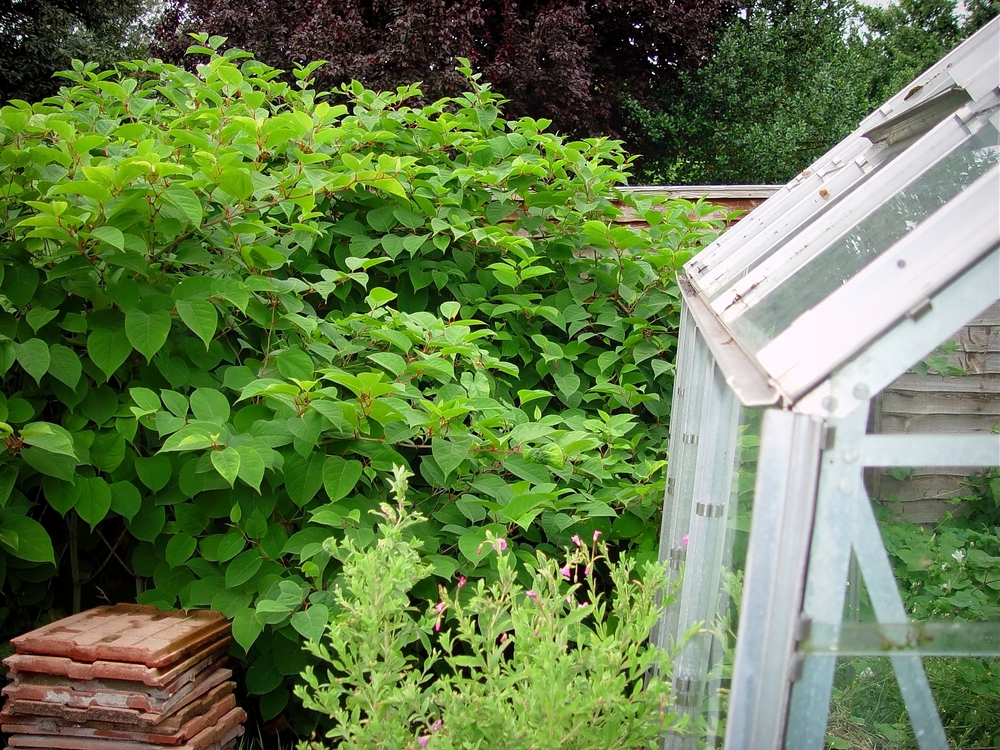
Summer and early autumn are when Japanese knotweed is at its most obvious, and also when it is most often mistaken for something else. By late summer a stand can be taller than a person, with dense leaves and frothy white flowers. This guide explains what to look for from June to November, using the Royal Horticultural Society's (RHS) published description, and what to do if you think you have found it.
If you are checking in the colder months, see our guides to knotweed in winter and knotweed in spring.
Summer (June to August): the key features
Stems
- Bamboo-like canes with conspicuous nodes (joints) along their length.
- Reddish-purple speckles on green stems. The RHS describes this speckling as a characteristic feature.
- Hollow centres. If a dead or cut stem is snapped, it is hollow inside.
- Height: the RHS says stems usually grow to about 2m (6½ft), reaching full height in late summer, when the tops often arch over.
Leaves
- Spade-shaped (shield or heart-like) green leaves with a flattish base, usually about 14cm (5½in) long, according to the RHS.
- Arranged in a zig-zag pattern, alternating along the stem rather than in opposite pairs. This is one of the most useful checks.
Growth habit
- Grows in dense clumps or thickets, often along fences, boundaries, railway lines and riverbanks.
- New shoots may push up through cracks in paths, patios or tarmac near an established stand.
Late summer to early autumn (August to October): flowers
The RHS says clusters of small creamy-white flowers form toward the tips of the stems in late summer and early autumn. They appear in loose, upright or slightly drooping sprays from where the leaves join the stem, and can make a stand look fluffy from a distance.
Almost all Japanese knotweed in the UK is female, so it does not spread by seed. The RHS notes that it spreads mainly from fragments of rhizome and stem; pieces of rhizome as small as about 1cm can grow into new plants. That is why cutting, strimming or digging it can make the problem worse.
Autumn (October to November): dieback
- As temperatures fall, the leaves turn yellow, then brown, and drop.
- Stems die back and turn brown and brittle, leaving hollow canes. The RHS says these may stay upright through winter in sheltered spots, or collapse into dry sections on the ground.
- Underground, the rhizome system stays alive but dormant, ready to shoot again in spring.
Autumn is not a reason to stop looking. Dead canes and leaf litter still show where a stand is, and that matters if you are buying or selling.
Quick checklist
| Feature | Japanese knotweed |
|---|---|
| Stems | Hollow, jointed, bamboo-like, green with reddish-purple speckles |
| Leaf shape | Spade or shield-shaped, flattish base, about 14cm long |
| Leaf arrangement | Alternate, in a zig-zag along the stem |
| Height by late summer | Usually around 2m, often arching |
| Flowers | Small creamy-white clusters, late summer to early autumn |
| Autumn | Leaves yellow then brown; brown hollow canes left behind |
Several plants share one or two of these features. Our guide to plants mistaken for Japanese knotweed explains how to rule them out, and knotweed vs bamboo covers the most common confusion.
Think you have found it? What to do next
- Do not cut, strim, mow or dig it. Fragments can spread it, and knotweed waste is classed as controlled waste under the Environmental Protection Act 1990. See knotweed disposal rules.
- Take clear photos: the whole plant, a close-up of a leaf, the stem showing nodes and speckling, and any flowers. Include something for scale.
- Note where it is in relation to your boundary, buildings and any neighbouring land.
- Get it identified. A specialist can confirm it from photos or a site visit.
It is not an offence to have Japanese knotweed in your garden, but the RHS notes it is an offence under the Wildlife and Countryside Act 1981 to plant it or cause it to grow in the wild, and councils can take action if it is not controlled. If it is coming from next door, see what to do if your neighbour has knotweed.
When to get a survey
Get a professional knotweed survey if:
- you are selling and need to answer the knotweed question on the TA6 property information form honestly (see the TA6 knotweed question);
- you are buying and the seller, a survey or a lender has raised knotweed (see buying a house with knotweed);
- a mortgage lender has asked for a report or management plan;
- it is close to a building or boundary and you need to know the extent before deciding on treatment.
Summer and early autumn are a good time for a survey because the plant is fully visible, but a trained surveyor can also identify it from winter canes and crowns.
Sources
- Royal Horticultural Society, "Japanese knotweed" advice guide: rhs.org.uk/weeds/japanese-knotweed
- GB Non-Native Species Secretariat identification sheets (listed under Fallopia japonica): nonnativespecies.org
Not sure what you have?
Send us clear photos of the stems, leaves and any flowers through the contact form, with your postcode, and we will help you work out the next step.